Today is National
Pet Travel Safety Day! A day to remind you to be aware of your pet’s safety during
travel. If you’re traveling by car, you should always have your dog in a
seat belt and your cat in a strapped-in carrier. If you have questions about
your pet’s safety during travel, don’t hesitate to ask us.

Showing posts with label San Lorenzo. Show all posts
Showing posts with label San Lorenzo. Show all posts
Wednesday, January 2, 2013

Wednesday, November 7, 2012
National Cat Week: Protect Your Cat This Season
It's National Cat Week! Have you heard about the danger of car engines for outdoor cats? Our car engines often stay warm for hours after our cars have been shut off, making the perfect warm place for an outdoor cat to sleep. If a car is started while a cat is lying on the engine, the cat could be injured or killed! Always knock on the hood of your car before you start it…you could save a life!
Friday, October 26, 2012
Halloween Safety Tips
It's Halloween night and the door bell is continuously ringing. This may be very frightening to your dog or cat or other pets. You need to have a game plan for them, as well, on Halloween night. Have a room set up for them and keep them behind closed doors during trick-or-treating hours. Have food, water, a toy or two and a litter box if needed all set up for them.
You saw the cutest costume for your pet! Just because you think a certain Halloween costume for your fur person is cute doesn't mean that they will enjoy wearing it! Try it on them in advance and see how they react. If they don't like it, don't force them to wear it.
If you own a cat and let it go outside, remember that this a bad time of year for cats. Vicious people tend to find Halloween an excuse to hurt or kill them. Keep them inside for a few days and nights. While they may whine a bit because they are used to going outside, they'll be safer in the house where you can keep an eye on them. There's no need for a pet to run free anyway, keep it home where it's safe all year long.
Having an adult party? Remember, dogs, cats, birds and other animals do not like being intoxicated. Some people at the party may think it's funny to get an animal drunk or high but it can kill them. It's better to hurt someone's feelings by telling them to leave the party than to deal with a seriously ill beloved pet.
Here are some tips to keep your pets happy on Halloween.
 |
As much as your dog or cat may beg for some of your Halloween candy, always remember that chocolate is deadly to them in any amount. There's a chemical that naturally occurs in chocolate that they can not tolerate.
|
|
If you work in a pet store, remember that this is the time of year that can be deadly for black cats. Some sick people who play at being what they'll call a Satanist will buy them to "sacrifice" If you can, don't take any black cats or sell them during October. Many pet stores won't take them anyway, just for this reason.
|
|
The wrappers, such as tin foil, can get stuck in your pets digestive tract and make them ill or cause death. There are plenty of recipes for making home made dog and cat treats, you can always make them on a Halloween theme if you want to make something special for your pet.
|
|
Large dogs can have lethal tails when it comes to wagging them. I've seen a German Shepherd that we used to have clear a coffee table in two seconds flat when she got excited. Don't leave any lighted candles or Jack-O-Lanterns where they could be knocked over by a swinging tail or by a curious cat. Not only could your pet start a fire but they could severely burn themselves in the process.
|
|
If you are going to dress your pet in a costume, keep in mind that unless the dog or cat is extremely receptive to this kind of thing, you could be causing it discomfort and stress. Some animals don't mind at all but others do not want to be bothered with this kind of thing. They'll be under enough stress with the festivities going on outside and people constantly at the door so don't cause them any more stress then you have to. You may love to dress in costume but then, you aren't a dog or a cat.
|
|
If a pet costume comes with a mask, don't use it. While some dogs will love dressing up, they usually aren't too keen on masks. If you do use a mask on your pet, make sure that it's eyes have plenty of room to see and that there is nothing covering it's nose or confining it's mouth.
|
|
If you are having a indoor party, make sure that you put your dog or cat in a room where they won't be disturbed. Even if your pet is ultra friendly and doesn't mind loud noises, music and lots of people you should keep them separate for the night. Also, be careful your cat or dog doesn't dart out through the open door as you hand out candy. Best bet is to just put them in a room with some food and water for the night and check on them once in a while to let them know everything is fine.
|
Friday, September 14, 2012
Friday, September 7, 2012
September is Senior Pet Month
At Arroyo Veterinary Clinic, we are focusing on senior pets this September! We are providing clients with 3 options for their senior pets this September.
1. Comprehensive Senior Wellness Test
2. Senior Wellness Visit
**Both the above options include discount packaged office visit, lab work and in-house testing at a discounted price.
3. For reluctant clients, we are still offering FREE office visit as a YELP.com Check-In Offer.

1. Comprehensive Senior Wellness Test
2. Senior Wellness Visit
**Both the above options include discount packaged office visit, lab work and in-house testing at a discounted price.
3. For reluctant clients, we are still offering FREE office visit as a YELP.com Check-In Offer.

We offer senior pet health care to help your pet live a long, healthy life. We recommend senior pets to come in for wellness exam every six months, due to changes that come with age.
These six-month wellness visits can be offered as first visit for vaccines, parasite screening and prevention. We will evaluate risk for infectious diseases and either increase interval between vaccines or discontinue some vaccines based on risk assessment. The second visit is recommended 6 months after first visit.
The focus during senior pet visits is to address old age concerns like arthritis, kidney disease, hyperthyroidism, cancer, glaucoma, hypertension etc. The lab work is recommended to provide us with baseline when the pet is well. Also in some cases it may help us identify certain conditions before disease signs are seen. With kidney disease, for example, by the time you see changes in the blood chemistries, 75 percent to 85 percent of the pet's kidneys could be gone, and, like people, pets need at least 50 percent to function. Now, if annual urinalysis is performed we can catch kidney disease at 65 percent and place the pet on a special diet or supplements to curb the problem.
Dog Age (years) | Wt:0-20 lb. | Wt:20-50 lb. | Wt:50-90 lb. | Wt.>90 lb. |
6 | 40 | 42 | 45 | 49 |
7 | 44 | 47 | 50 | 56 |
8 | 48 | 51 | 55 | 64 |
9 | 52 | 56 | 61 | 71 |
10 | 56 | 60 | 66 | 78 |
11 | 60 | 65 | 72 | 86 |
12 | 64 | 69 | 77 | 93 |
13 | 68 | 74 | 82 | 101 |
14 | 72 | 78 | 88 | 108 |
15 | 76 | 83 | 93 | 115 |
16 | 80 | 87 | 99 | 123 |
17 | 84 | 92 | 104 | 131 |
18 | 88 | 96 | 109 | 139 |
19 | 92 | 101 | 115 | - |
20 | 96 | 105 | 120 | - |
Use this table to determine the “true” age of a dog or cat:
(Senior years are highlighted in red font.)
Cat Age (years) | Weight: 0-20 lb. |
8 | 48 |
9 | 52 |
10 | 56 |
11 | 60 |
12 | 64 |
13 | 68 |
14 | 72 |
15 | 76 |
16 | 80 |
17 | 84 |
18 | 88 |
19 | 92 |
20 | 96 |
Thursday, September 6, 2012
Autumn Road Trip with Pets
Going on an adventure with your family this fall? If you’re bringing your pet, make sure you go fully prepared! Bring the appropriate amount of food for the length of your trip, make sure your contact information is updated on your pet’s microchip, and your pet is up-to-date on flea, tick, and heartworm preventatives. Strange pests and illnesses can be contracted in new places, so it’s important to make sure that your pet is protected at all times.

Monday, August 27, 2012
Can Pets Predict the Weather, Among Other Things?
Summer means it is storm season. You may not have to check with the weather service to find out if lightning is about to strike, however. The answer could be curled up in your lap or resting at your feet. According to a survey by the Associated Press and Petside.com, more than two-thirds of dog and cat owners say they’ve received weather warnings from their pets. Even more surprisingly, almost half report they’ve been alerted to bad news by their animals. Do pets really have this mysterious “sixth sense”?
“It’s not that they have a sixth sense but that their senses are much more acute than those of humans,” says Dr. Nicholas Dodman, professor of animal behavior at the Tufts Cummings School of Veterinary Medicine.
“For example, a dog’s most highly developed sense is its ability to smell,” he explains. “We humans have something like 12 million olfactory receptors in our noses. Dogs can have up to 4 billion. So, it’s hardly surprising that they have an incredible ability to detect trace amounts of odors.”
“So, let’s suppose a storm is miles and miles away and lightning flashes. That may generate ozone molecules that travel in the breeze ahead of the storm. Your dog smells those and becomes agitated and starts to shake.”
“Then, when the storm hits, you think, ‘Oh, my goodness, my dog has a sixth sense!’”
Hart says animals that have been frightened by thunderstorms in the past will be especially attuned to all the stimuli that accompany them.
Static electricity might also play a role in an animal’s ability to “predict” the weather.
“People have reported getting shocks off their dogs during storms,” says Dodman. “That’s not unusual, considering that dogs are running around on insulated foot pads wearing the equivalent of a big furry angora sweater. They’re perfectly designed to acquire a static charge. So, when they touch their nose to something, they are shocked and will remember that painful experience.”
How do these scientists explain a dog or cat’s reported ability to foretell bad news?
“We tend to remember those things that impress us the most,” says Hart. “So, if our dog appears to warn us and something bad happens afterward, we’ll remember that. But we’ll forget the other hundred or thousand times he acted that way and we didn’t get bad news.”
How Do Pets Warn of Impending Danger?
|
He likens it to a baseball player who discovers a hole in his sock on the day of a big game. He hits a home run and wears a sock with a hole in it for the rest of his career.
“The sock didn’t cause the home run,” Dodman says. “It’s just that humans often make the wrong connection.”
If it’s any consolation, however, he says that dogs and cats make wrong connections, too.
“Your pet may be frightened by the smell of lamb cooking. That’s maybe because he once burned his nose on the stove and he associates that painful experience with the smell, not the hot burner.
“It’s easy for us to misinterpret what’s really going on,” Dodman adds. “Like when you’ve had a bad day at the office and come home and your dog puts his head on your lap. Your response is, ‘My dog knew I had a bad day at work.’ He didn’t. He just knew when you walked in the door that your posture was different and you looked sad. It’s your body language. Dogs can read you like a book.”
“It’s natural to assume more understanding and human sense than there is,” says Hart. “But when you say that to people like my sister, she’ll tell me, ‘No, Ben, you’re wrong. I know my dog really understands what I’m going through or what happened.’”
“You just can’t argue with that.”
This article originally appeared in PetsMatter May / June 2011, published by the American Animal Hospital Association. Copyright © 2011 AAHA.Find out more.
Wednesday, August 22, 2012
Pets & Truck Beds
Did you know that letting your pet ride in the bed of your truck can be extremely dangerous, even if you’re traveling at low speeds? Dogs are known to jump and run after things or animals that appeal to them, and jumping from a moving vehicle can cause serious injury. We ask that you NEVER let your pet ride in the back of a truck, but always inside where they are safely secured.
Tuesday, August 21, 2012
Pets & Pool Safety
Keeping your pool closed off securely with a gate is essential to keeping your own children and pets, and those of the whole neighborhood, safe. Some pets get a taste of swimming and love it so much they want to go in for a dip every day—even when you’re not around. A locking gate that is tall enough to discourage jumping is the best way to avoid potential tragedies in your own backyard.

Friday, August 17, 2012
Hiking & Pets
Are you planning on taking your dog hiking this summer? Consider investing in a comfortable leash and harness before your trip. A proper harness can help your dog feel comfortable while walking on the trail, and can help you keep better track of them if they try to get loose. (You know the sight of a wild animal or another dog can make your dog tug on the leash!) And don’t forget, take your dog on pet-friendly trails only—these have been approved for your dog’s safety!
Thursday, August 16, 2012
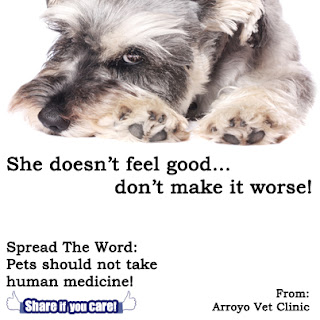
Over-the-Counter Medications & Pets
Pets are often curious creatures, wanting to check out things around the house. Because of this characteristic, it’s important to always store dangerous substances like medicine far from their reach. Pets have been known to accidentally ingest whole packages of pills and the results are often serious, sometimes fatal. Keep your pet’s safe at home by storing your medicine safely out of their reach.

Wednesday, August 15, 2012
Heartworm
Your pet’s exposure to heartworms and other parasites is a year round concern. Checking for parasites is especially important in households with children present, because parasites are easily transmittable from pets to children. With unpred
ictable weather and pets that often travel into different climates, we recommend a year round preventative for adequate protection. Remember, heartworm prevention is much more successful and economical than treatment for the disease!
Wednesday, August 1, 2012

Thursday, July 12, 2012
Prevent your pet from starting fires
Extinguish open flames: Pets are generally curious and will investigate cooking appliances, candles, or even a fire in your fireplace. Ensure your pet is not left unattended around an open flame and make sure to thoroughly extinguish any open flame before leaving your home.
Remove stove knobs: Be sure to remove stove knobs or protect them with covers before leaving the house – a stove or cook top is the number one piece of equipment involved in your pet starting a fire.
Invest in flameless candles: These candles contain a light bulb rather than an open flame, and take the danger out of your pet knocking over a candle. Cats are notorious for starting fires when their tails turn over lit candles.
Beware of water bowls on wooden decks: Do not leave a glass water bowl for your pet outside on a wooden deck. The sun's rays when filtered through the glass and water can actually heat up and ignite the wooden deck beneath it. Choose stainless steel or ceramic bowls instead.
Pet proof the home: Take a walk around your home and look for areas where pets might start fires inadvertently, such as loose wires and other potential hazards.
Keep your pets safe
Keep pets near entrances when away from home: When leaving pets home alone, keep them in areas or rooms near entrances where firefighters can easily find them.
Secure young pets: Especially with young puppies, keep them confined away from potential fire-starting hazards when you are away from home, such as in crates or behind baby gates in secure areas.
Practice escape routes with pets: Keep collars and leashes at the ready in case you have to evacuate quickly with your pet or firefighters need to rescue your pet.
Consider using monitored smoke detection services: As an added layer of protection beyond battery-operated smoke alarms, smoke detectors connected to a monitoring center help save pets who can't escape when left home alone.
Affix a pet alert window cling: Write down the number of pets inside your house and attach the static cling to a front window. This critical information saves rescuers time when locating your pets. Make sure to keep the number of pets listed on them updated.
Subscribe to:
Posts (Atom)